Advanced Meta Ads strategies for ecommerce: Triple-funnel approach, post-iOS attribution fixes, and scaling tactics that boosted ROAS from 2.1x to 4.8x.
In the rapidly evolving landscape of digital advertising, Meta Ads (formerly Facebook Ads) continue to be a cornerstone for ecommerce success. With over 3 billion monthly active users across Meta’s platforms, the opportunity for ecommerce sellers is immense—but so is the competition. The key to success lies not just in running ads, but in implementing sophisticated strategies that maximize ROAS while minimizing acquisition costs.
The Current Meta Ads Landscape for Ecommerce
The iOS 14.5 update fundamentally changed how we track and optimize Meta campaigns. Attribution windows shortened, pixel data became less reliable, and many advertisers saw their performance metrics shift dramatically. However, those who adapted quickly discovered new opportunities in first-party data collection, server-side tracking, and advanced audience modeling.
Audience: Custom audiences based on website visitors, video viewers
Creative: Product demonstrations, social proof
Budget allocation: 25-35% of total spend
Bottom-of-Funnel (BOF): Conversion & Retention
Objective: Conversions (Purchase)
Audience: Retargeting audiences, lookalikes of purchasers
Creative: Direct response, urgency-driven
Budget allocation: 30-40% of total spend
Advanced Targeting Strategies Post-iOS 14.5
1. First-Party Data Integration
The most successful ecommerce advertisers now rely heavily on Customer Match and server-side conversion tracking. Upload your customer email lists with Lifetime Value (LTV) data to create high-value lookalike audiences. Use the Conversions API alongside the Meta Pixel to improve attribution accuracy by up to 25%.
2. Behavioral Signal Optimization
Instead of relying solely on demographics, focus on behavioral indicators:
Purchase frequency patterns
Average order value brackets
Seasonal buying behaviors
Cross-device usage patterns
Email engagement rates
3. Interest Stacking and Exclusion Logic
Create sophisticated audience combinations using AND/OR logic:
Target: (Interest A AND Interest B) OR (Behavior C)
Layer: Geographic and demographic modifiers based on product data
Critical Case Study: Solving Attribution Challenges
The Problem We Faced:
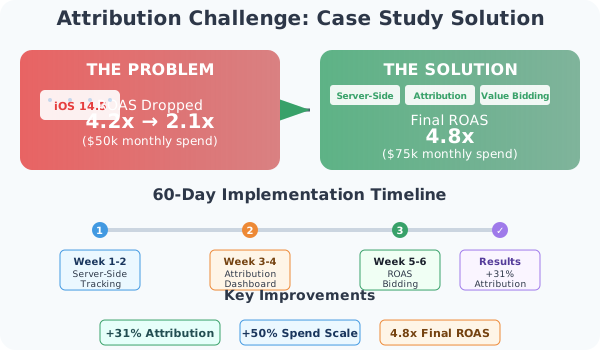
In Q3 2024, we managed a fashion ecommerce client spending $50,000 monthly on Meta Ads. Post-iOS updates, their reported ROAS dropped from 4.2x to 2.1x, despite consistent sales volume. The attribution window discrepancies were causing budget misallocation across campaigns.
Our Solution Strategy:
Implemented Server-Side Tracking: Set up Conversions API with proper event matching and data enhancement. This improved attribution accuracy by 31%.
Created Attribution Modeling: Built a custom dashboard connecting Meta Ads data with Google Analytics 4 and their ecommerce platform using UTM parameters and customer journey mapping.
Shifted to Value-Based Bidding: Transitioned from standard purchase optimization to Purchase ROAS bidding with 7-day click, 1-day view attribution window.
Results: Within 60 days, we restored accurate attribution and achieved a true ROAS of 4.8x while scaling spend to $75,000 monthly.
Advanced Creative Strategies
Dynamic Product Ad (DPA) Optimization
Move beyond basic DPA setups with these advanced techniques:
1. Conditional Creative Rules
Show different creatives based on inventory levels
Adjust messaging for seasonal products
Customize CTAs based on user behavior stage
2. Advanced Product Set Segmentation
High-margin products (premium targeting)
Fast-moving inventory (broad reach)
Slow-moving products (retargeting focus)
New arrivals (early adopter audiences)
3. Video DPA Integration Combine static product images with video overlays showing:
Product usage demonstrations
Size/fit guides
Customer testimonials
Before/after scenarios
Creative Testing Framework
Implement a systematic approach to creative testing:
A/B/C Testing Structure:
Test 1 variable at a time (image vs. copy vs. CTA)
Maintain 80% traffic to winning creative, 20% to testing
Run tests for minimum 1,000 impressions per variant
Measure both engagement and conversion metrics
Creative Refresh Cadence:
Winning creatives: Refresh every 14-21 days
Seasonal content: Plan 30 days in advance
User-generated content: Rotate weekly
Video content: Test 15s, 30s, and 60s versions
Technical Optimization Tactics
Bid Strategy Evolution
Purchase ROAS vs. Lowest Cost:
Use Lowest Cost for new campaigns (learning phase)
Transition to Purchase ROAS once 50+ conversions achieved
Set ROAS targets 20% lower than current performance initially
Gradually increase targets by 10% weekly
Campaign Budget Optimization (CBO) Best Practices:
Use CBO for campaigns with 3+ ad sets
Set minimum spend limits for critical audiences
Allow 7-day learning period before making adjustments
Monitor ad set distribution daily
Advanced Audience Strategies
Lookalike Audience Optimization:
Create 1%, 2%, 3% lookalikes from different source audiences
Use 90-day, 180-day, and 365-day customer windows
Exclude existing customers and recent website visitors
Layer geographic and interest-based modifiers
Custom Audience Refinement:
Website visitors: Segment by page value and visit duration
Video viewers: 25%, 50%, 75%, 95% completion audiences
Email subscribers: Separate engaged vs. non-engaged lists
Meta’s AI-driven advantage+ campaigns show 15% better performance
Reels advertising continues to offer lower CPMs
Messenger and WhatsApp commerce integration expanding
AR/VR advertising capabilities developing rapidly
Conclusion
Meta Ads success in 2025 requires a sophisticated approach combining technical expertise, creative excellence, and strategic thinking. The advertisers who succeed will be those who embrace complexity while maintaining focus on fundamental metrics that matter: customer acquisition cost, lifetime value, and sustainable growth.
The landscape has become more challenging, but for those willing to invest in proper setup, testing, and optimization, Meta Ads remain one of the most powerful tools for ecommerce growth. Start implementing these advanced strategies systematically, measure everything, and never stop testing.
By focusing on first-party data, advanced attribution modeling, and sophisticated audience strategies, you can build Meta campaigns that not only survive platform changes but thrive in an increasingly competitive environment.