
You spend hours pulling data, formatting charts, and writing commentary. The client opens the PDF, glances at the first page, and replies with one line: “Looks good, thanks.” Three months later, they ask what exactly they are paying for.
If that sounds familiar, the problem is rarely your SEO. It’s the report.
For agencies that resell or outsource SEO, reporting is the one deliverable the client sees every single month. It is the proof of work, the retention tool, and often the only thing standing between “great partner” and “let’s try someone cheaper.” This guide covers how to build white-label SEO reports that get read, trusted, and renewed, whether your fulfilment is in-house or delivered by a partner.
What “White-Label” Actually Means in Reporting
White-label reporting means the client sees your agency’s name, logo, and colours, with no trace of the tool or the fulfilment partner behind the data.
There are really three levels:
- Cosmetic: your logo and colours on an exported PDF
- Branded delivery: reports sent from your own email address and, ideally, hosted on your own domain
- Full portal: a client login that looks and feels like part of your agency
Be honest with yourself about which level you deliver. A logo on top of a raw data export is not the same thing as a report designed for a business owner. If you work with an offshore or outsourced SEO team, as many agencies now do (we explain why in our post on why agencies are outsourcing SEO projects), reporting is also where you stay in control of the client relationship while someone else handles the heavy lifting.
Why Most SEO Reports Get Ignored
Reports fail for predictable reasons:
- They are data dumps. Twenty charts with no story. The client has to work out what matters.
- They lead with vanity metrics. Impressions and “average position” mean little to a plumber who wants more calls.
- They hide the work. If the report doesn’t show what was actually done this month, the client assumes nothing was.
- They ignore context. A traffic dip in December for a B2B manufacturer is normal. Without explanation, it looks like failure.
- They are too long. Most clients give a monthly report a couple of minutes, not twenty.
The fix is not more data. It’s a clearer structure.
The Report Structure That Works
A strong white-label SEO report fits in roughly five to eight pages and follows a consistent order. Here is a structure we recommend.
1. Executive Summary (the only section guaranteed to be read)
Three to five sentences, written in plain English. What happened this month, what it means for the business, and what happens next. Example: “Calls from organic search rose compared with last month, driven by the new service-area pages. Two keywords moved onto page one. Next month we focus on reviews and a technical fix that is slowing mobile pages.”
2. Business Outcomes First
Lead with what the owner cares about: leads, calls, form submissions, direction requests, and revenue where tracked. Tie organic traffic to conversions, not just visits. If you have not set up conversion tracking properly, fix that before anything else, because without it you are reporting activity, not impact.
3. Work Completed This Month
This section protects your retention. List what was actually delivered: pages published or optimised, links built, technical fixes made, citations cleaned, Google Business Profile updates. Specific beats vague. “Published 4 location pages and fixed 12 broken internal links” is more convincing than “ongoing optimisation.”
4. Rankings and Visibility, Kept in Perspective
Show movement for a focused set of priority keywords, not all 300. Group them by intent or service line. For local clients, include map pack visibility alongside organic positions. Explain movement honestly, up or down.
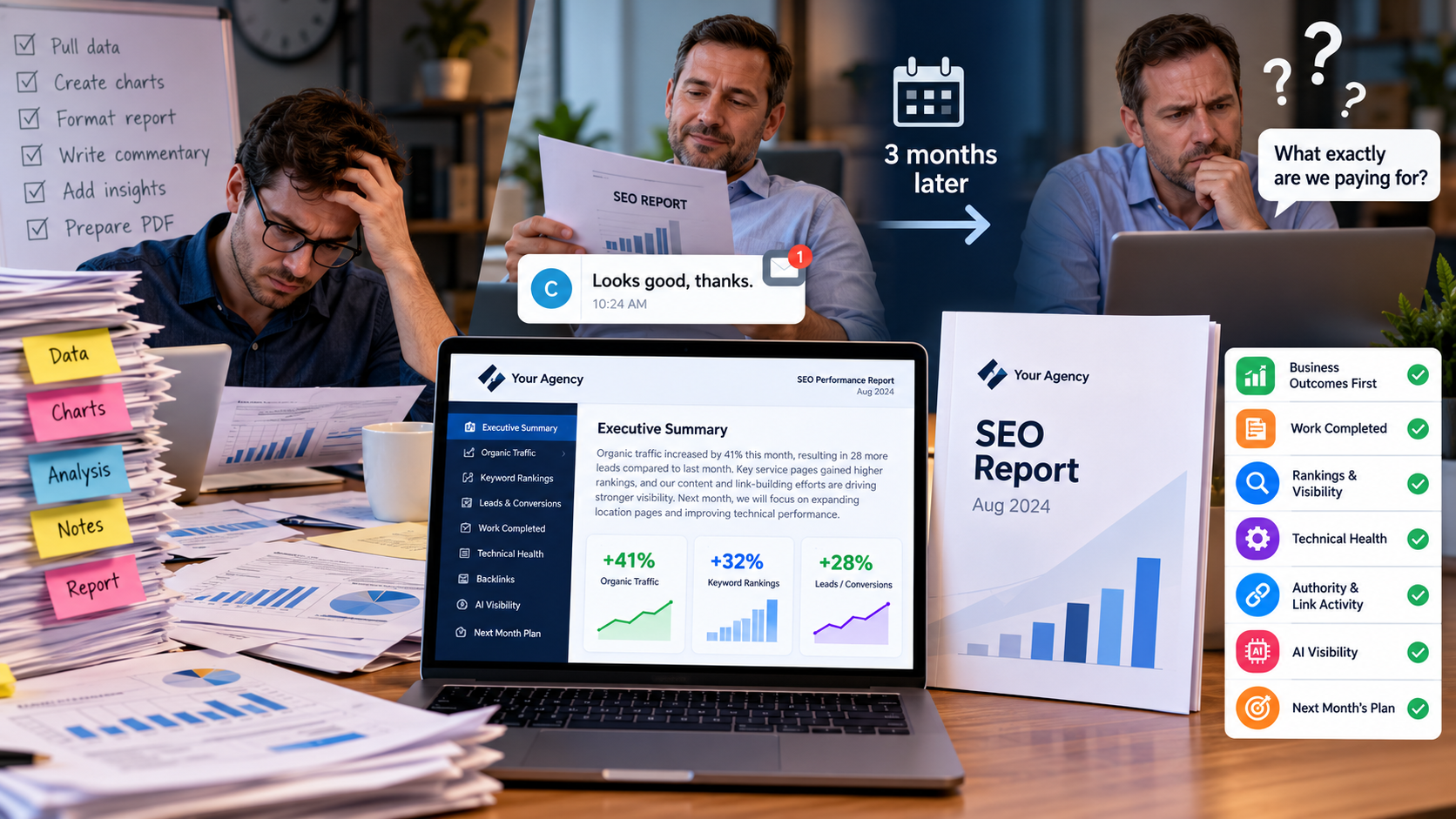
5. Technical Health Snapshot
Clients rarely see technical problems, so surfacing them builds trust. Keep it short: what was found, what was fixed, what still needs attention. If page speed is an issue, link the finding to your plan, and point them to your guidance on Core Web Vitals and page speed so they understand why it matters.
6. Authority and Link Activity
Summarise new quality links earned or built and the sites they came from. This is where partners who specialise in link building can supply clean, reportable data you can drop straight into your template.
7. AI and Generative Search Visibility
This is the section most agencies still skip, and clients are starting to ask about it. Track whether the brand is being mentioned or cited in AI answers for a handful of key questions, and note changes over time. Our guide on getting cited by AI Overviews, ChatGPT and Perplexity explains what to look for. Even a simple monthly check, documented consistently, makes you look ahead of the curve.
8. Next Month’s Plan
Three to five priorities, each tied to a goal. This turns the report from a rear-view mirror into a roadmap and makes the next conversation easier.
Choosing Data Sources and Tools
You do not need a complicated stack. Most agencies pull from:
- Google Search Console for queries, clicks, and indexing
- Google Analytics 4 for traffic and conversions
- A rank tracker for priority keywords
- A backlink tool for link activity
- Google Business Profile insights for local clients
You can combine these in a dashboard tool such as Data Studio, which lets you build a reusable, branded template and refresh it each month instead of rebuilding from scratch. When comparing any reporting platform, check how deep its white-labelling goes: custom domain, custom sender email, and whether client-facing pages carry any vendor branding.
A Simple Monthly Reporting Workflow
Reporting should take a fraction of the time it takes today. A workable rhythm looks like this:
- Week 4: collect data and update the dashboard
- Write the summary last, after you have seen the numbers, in plain language
- Add one insight per section, not ten
- Send a short email with the key win and one thing you need from the client, then attach or link the full report
- Offer a 15-minute call each quarter instead of long monthly meetings
If your fulfilment partner supplies a work log, merge it into the “work completed” section so you never have to chase details.
Reporting for Outsourced and White-Label Fulfilment
When SEO is delivered by a partner, reporting needs a clear handover. Agree up front on:
- What data the partner supplies (work logs, link sheets, audit findings)
- The format, so it drops into your template with no rework
- The deadline, a few days before your client send date
- Who explains anomalies, so you are never surprised in a client call
A good partner makes you look organised, not dependent. If you are weighing this model, our breakdown of affordable, safe, customisable SEO outsourcing for agencies shows what to expect.
Common Reporting Mistakes to Avoid
- Reporting only what went well. Clients trust agencies that explain dips honestly.
- Using jargon. Replace “SERP volatility” with “Google reshuffled results this month.”
- Skipping the benchmark. Compare against the previous month and the same month last year where possible.
- Overpromising in the plan. Only list next steps you can deliver.
- No ties to money. Even a rough estimate of lead value helps clients see return.
Final Thoughts
A great SEO report does three things: it proves the work, shows the outcome, and makes the next step obvious. Get that right and reporting stops being a monthly chore and becomes your best retention asset.
If you want a fulfilment partner that supplies clean, report-ready data and delivers under your brand, our team works with agencies every day. Explore our SEO services, see how white-label partnerships work, or get in touch to talk through your reporting setup.
