
A patient searching for “dentist near me open now” or “pediatrician accepting new patients” isn’t browsing casually — they’re often dealing with pain, worry, or a child who needs care today. That urgency is exactly why healthcare SEO behaves differently from almost every other industry: the decision window is short, the trust bar is high, and Google treats medical content with extra scrutiny because it falls under YMYL (Your Money or Your Life) guidelines.
For independent doctors, dental practices, physiotherapy clinics, and small multi-provider practices, this creates both a challenge and an opportunity. The challenge is that generic SEO advice — the kind written for e-commerce or SaaS — doesn’t map cleanly onto healthcare. The opportunity is that most local competitors are still making the same avoidable mistakes, which leaves real room to win the map pack and the first page with a properly built strategy.
Why Healthcare Search Behavior Is Different
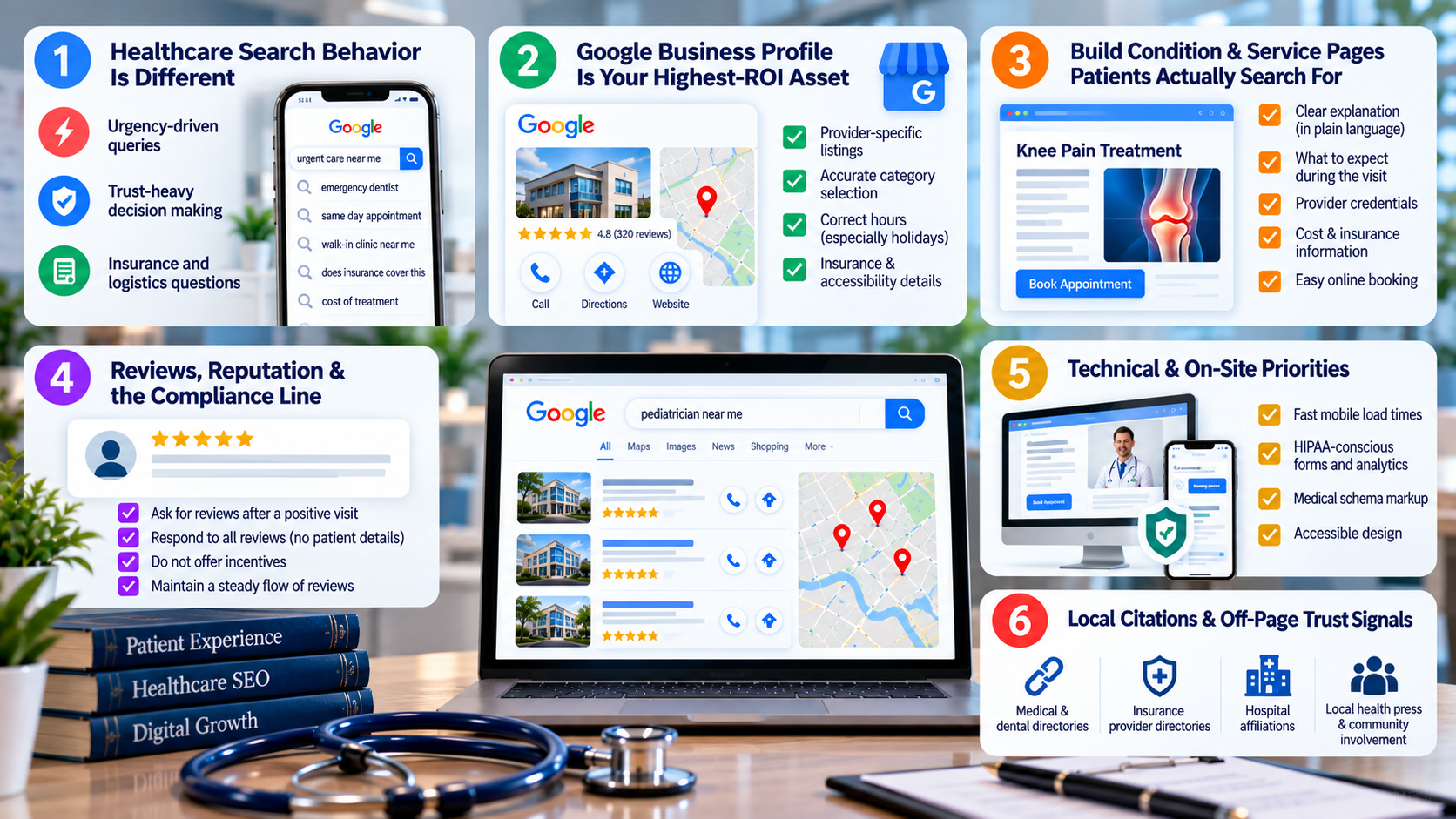
Before touching tactics, it’s worth understanding the three things that make patient search behavior unique:
- Urgency-driven queries (“emergency dentist,” “same day appointment,” “walk-in clinic near me”) that need to surface fast, mobile-friendly answers
- Trust-heavy decision making — patients are choosing who touches their body or their child’s health, so credentials, reviews, and clear communication matter more than almost any other purchase decision
- Insurance and logistics questions baked into the search itself (“does [clinic] take [insurance],” “cost of a root canal without insurance”) that content needs to address directly, not vaguely
A practice that ignores these patterns and simply lists services with no supporting detail is competing on a much weaker footing than one that answers the actual decision-making questions up front.
Step 1: Google Business Profile Is Often Your Highest-ROI Asset
For most local healthcare practices, the map pack drives more new-patient calls than the website itself. A few specifics that matter more in healthcare than in most other verticals:
- Provider-specific listings — if you have multiple doctors or dentists at one location, individual provider profiles (linked to the main practice page) can capture searches for a specific practitioner’s name plus specialty
- Accurate category selection — “Family Medicine Practice” versus “Doctor” versus “Medical Clinic” all carry different ranking weight for different query types, so specificity matters
- Hours accuracy, especially holidays — few things frustrate a patient (and hurt your profile’s engagement signals) more than showing up to a closed office
- Insurance and accessibility details filled into the profile description and website, since this is one of the first things patients filter by
If your practice hasn’t reviewed its Google Business Profile setup in the last year, this is usually the fastest place to find quick wins before touching anything else.
Step 2: Build Condition and Service Pages Patients Actually Search For
Just like legal SEO, healthcare SEO suffers when every service is crammed onto one generic page. Patients don’t search “our services” — they search for the specific problem or procedure: “TMJ treatment,” “ingrown toenail removal,” “postpartum checkup,” “sports injury physiotherapy.”
A well-built service or condition page should include:
- A clear, plain-language explanation of the condition or procedure (avoid jargon that assumes medical literacy)
- What to expect during the visit — this single detail reduces patient anxiety more than almost anything else on the page
- Provider credentials directly linked from the page, showing who actually treats this condition at your practice
- Answers to the logistical questions patients have before booking: cost ranges, insurance acceptance, typical appointment length
- A clear, low-friction way to book — ideally without forcing a phone call as the only option
Practices that build this depth typically see these pages start ranking for dozens of long-tail, high-intent searches that a generic “services” page could never capture individually.
Step 3: Reviews, Reputation, and the Compliance Line
Reviews are arguably the single strongest trust signal in healthcare search — but this is also the area where practices most often cross ethical or regulatory lines without realizing it.
Do:
- Ask for reviews at a natural point after a positive visit, through a simple, low-friction link (text or email)
- Respond to every review, thanking positive reviewers generically and never confirming any specific treatment, diagnosis, or visit detail in a public reply — this protects patient privacy regardless of jurisdiction
- Route complaints to a private channel first, giving the practice a chance to resolve the issue before it plays out publicly
Avoid:
- Offering any discount, gift, or incentive in exchange for a review
- Asking staff to leave reviews on behalf of patients, or writing reviews internally
- Referencing any specific patient detail, treatment, or outcome in a public review response, even to correct a factual error
A steady, natural flow of reviews — even five or six a month — tends to outperform a one-time push for fifty reviews that then goes quiet. Search engines read consistency as a signal of an active, trustworthy, ongoing practice. For a deeper breakdown of sustainable review generation, see our guide on organic ways to get more reviews.
Step 4: Content That Demonstrates Real Expertise (E-E-A-T Matters Most Here)
Google’s helpful content guidance explicitly calls out medical and health content as an area where Experience, Expertise, Authoritativeness, and Trust carry extra weight. This means:
- Provider bylines matter. Blog content should be visibly written or reviewed by an actual practitioner, with credentials linked, not published anonymously
- Avoid diagnostic language that could be read as personalized medical advice rather than general education — this protects both your patients and your practice from liability
- Cite recognized medical sources where appropriate (professional associations, public health bodies) to reinforce authority without overstating claims
- Answer the pre-appointment questions directly — “is a lump under the skin always serious,” “how long does recovery from [procedure] take,” “when should a fever require a doctor visit” — this is exactly the kind of content that also gets surfaced in AI-generated answers and Google’s featured snippets when it’s well-structured and clearly sourced
This is increasingly relevant for AI-driven search tools as well. When someone asks an AI assistant a health-related question, well-attributed, clearly credentialed content is far more likely to be cited than an unsigned generic article. Our guide on GEO, AEO, and their impact on SEO strategy covers how to structure content specifically for this shift.
Step 5: Technical and On-Site Priorities for Healthcare
- Fast mobile load times — a huge share of urgent-care searches happen on a phone, often on a poor connection, and slow sites lose these visitors before they even see the content
- HIPAA-conscious forms and analytics setup — appointment request forms and any chat widgets need to be configured so patient data isn’t inadvertently exposed to third-party tracking tools
- Schema markup for MedicalOrganization, Physician, and FAQPage to help both search engines and AI tools understand your practice’s specialties and provider details accurately
- Accessible design — larger text options, sufficient color contrast, and screen-reader compatibility matter more in healthcare than almost any other industry, given the demographic range of patients
If your site hasn’t had a technical audit recently, it’s worth reviewing against our technical SEO checklist before investing further in content.
Step 6: Local Citations and Off-Page Trust Signals
Healthcare-specific directories and citations carry particular weight:
- Medical and dental directories relevant to your specialty (beyond just general business directories)
- Insurance provider directories, since being listed accurately here often drives direct referral traffic
- Hospital or health-system affiliations, if applicable, linked and referenced clearly
- Local health-related press or community involvement (health fairs, school partnerships, sponsorships)
As with legal SEO, quality and relevance outperform volume — a handful of citations from recognized medical directories will do more for your credibility than dozens of generic local listings.
Common Healthcare SEO Mistakes to Avoid
- One generic “services” page instead of individual condition/procedure pages
- No provider bios or credentials visible on service pages, which weakens both patient trust and Google’s E-E-A-T assessment
- Ignoring insurance and cost questions in content, forcing patients to call just to find out if they’re even a fit
- Copy-pasted content across multiple clinic locations with only the city name changed
- Slow, image-heavy websites that lose mobile visitors before the page even finishes loading
Bringing It All Together
Healthcare SEO rewards the practices willing to build real depth: individual condition pages, visible provider credentials, a well-maintained Google Business Profile, and a steady, ethical review pipeline. It’s a slower build than more transactional industries, but the payoff compounds — a well-optimized healthcare presence keeps generating new-patient inquiries long after the initial investment, and it’s becoming the deciding factor in whether AI-driven health searches even mention your practice.
If you’d like a clear picture of where your practice currently stands before investing further, our SEO services team can run a full audit, or you can start with a free SEO audit report to see the highest-impact gaps first.
