
Somewhere in the last two years, a meaningful chunk of search behavior quietly shifted. People still type questions into Google, but a growing share of them are now met with an AI-generated summary before they ever see a traditional blue link — and a separate, fast-growing group is skipping Google altogether, asking ChatGPT, Perplexity, or Claude directly instead.
For businesses that spent years optimizing for the ten blue links, this shift raises an uncomfortable question: what happens to your visibility when the “search result” is a synthesized paragraph with two or three citations, instead of a full page of ranked links?
This is the world Generative Engine Optimization (GEO) — sometimes called AI Search Optimization or Answer Engine Optimization (AEO) — exists to address. It isn’t a replacement for SEO; it’s an additional layer built on top of the same foundation, with a few specific differences in what gets rewarded.
How AI Overviews and Chat-Based Search Actually Choose Sources
Traditional Google ranking and AI-generated answers use overlapping but not identical signals. Both systems still care about crawlability, authority, and relevance — but generative systems add a few extra filters:
- Extractability — can the system pull a clean, self-contained fact or answer from your content without needing to interpret ambiguous context?
- Corroboration — is the same claim supported by multiple independent, credible sources, or does your page stand alone making the claim?
- Recency and specificity — vague, evergreen-sounding claims are less likely to be cited than specific, dated, sourced information
- Structural clarity — content organized into clear questions and direct answers is dramatically easier for an AI system to extract and attribute than a long, meandering narrative
In practice, this means the content that wins in generative search often looks different from the content that wins in traditional rankings — even though the underlying topical authority still matters just as much.
Step 1: Structure Content Around Direct, Extractable Answers
AI systems tend to pull the sentence or short passage that most directly and unambiguously answers a question — not the cleverest writing, and not the most keyword-dense paragraph. This favors a specific content structure:
- Lead with the answer, then explain the reasoning or nuance afterward — the inverted-pyramid approach journalists have used for decades works well here for exactly this reason
- Use explicit question-and-answer formatting (H2/H3 headers phrased as actual questions, followed immediately by a direct answer) rather than burying the answer three paragraphs into a section
- Keep individual claims self-contained — a sentence like “our average client sees a 34% increase in local pack visibility within 90 days” is far more extractable than a sprawling paragraph that requires the reader (or the AI) to piece the claim together from context
This is the same underlying principle behind ranking for Google’s featured snippets and “People Also Ask” boxes — AI Overviews and chat-based answers are, in many ways, an extension of that same extraction logic, applied more broadly.
Step 2: Schema Markup Is No Longer Optional
Structured data (schema markup) gives search engines and AI systems an explicit, machine-readable description of what your content actually is, rather than forcing them to infer it from unstructured text. For most businesses, the highest-priority schema types are:
- FAQPage — directly maps question-and-answer content, making it easy for AI systems to extract discrete Q&A pairs
- Organization and LocalBusiness — establishes clear, structured facts about who you are, where you operate, and what you do
- Article and Author — attaches clear authorship and publication data to content, reinforcing the trust signals generative systems weigh heavily
- Review and AggregateRating — where genuinely applicable, gives AI systems a structured way to represent trust and reputation signals
You can validate structured data implementation using Schema.org’s own documentation as a reference, and Google’s Rich Results testing tools to confirm it’s being read correctly.

Step 3: Understand and Use llms.txt Where It Matters
Alongside traditional robots.txt, a growing (though still emerging) convention called llms.txt allows sites to provide AI crawlers with a clean, curated summary of key pages and resources — essentially a site map written specifically for language models rather than search engine crawlers. While adoption and support vary across AI platforms and this convention is still evolving, implementing a basic, accurate llms.txt file is a low-cost way to make sure your most important content is easy for AI systems to locate and correctly interpret, without waiting for the standard to fully mature.
This doesn’t replace good technical SEO fundamentals — clean site architecture, fast load times, and clear internal linking remain the backbone that both traditional crawlers and AI systems depend on. If your technical foundation hasn’t been reviewed recently, our technical SEO guide is a useful starting point before layering AI-specific optimization on top.
Step 4: Build Corroborated, Multi-Source Authority — Not Just On-Site Claims
Because generative systems weigh corroboration heavily, a claim that only ever appears on your own website is inherently weaker than one supported across multiple credible, independent sources. This is where traditional off-page SEO and GEO overlap directly:
- Consistent facts across your site, directories, and press mentions reinforce each other rather than contradicting or duplicating vaguely
- Third-party validation — genuine customer reviews, case studies referenced by partners, or coverage in trade publications — gives AI systems independent confirmation of claims your own site makes about itself
- Digital PR and guest contributions on legitimate, relevant publications create the kind of external corroboration that pure on-site content can never achieve alone
This is fundamentally the same discipline behind sustainable link building, just evaluated through a slightly different lens. Our link building services approach already prioritizes exactly this kind of genuine, relevant, corroborating authority over volume-based tactics.
Step 5: E-E-A-T Matters Even More in Generative Search
Google’s own helpful content guidance around Experience, Expertise, Authoritativeness, and Trust was already a major ranking factor before AI Overviews existed — but it becomes even more decisive in generative search, because an AI system citing a source is implicitly vouching for it in a way a simple blue link doesn’t.
Practical steps that reinforce E-E-A-T for both traditional and generative search:
- Visible author bylines with real credentials and, where relevant, a linked author bio page
- Clear “last updated” dates on content that covers anything time-sensitive (pricing, regulations, product specs)
- Transparent sourcing — linking out to the primary data or study behind a claim, rather than presenting it as an unsupported assertion
- Genuine first-hand experience reflected in the content (case studies, real examples, specific numbers) rather than generic, could-apply-to-anyone statements
We’ve covered this in more depth in our earlier piece on Google’s E-E-A-T and AI content, which remains directly relevant as generative search continues to lean on the same underlying trust signals.
Step 6: Monitor Whether You’re Actually Being Cited
Unlike traditional rank tracking, measuring GEO performance is still a maturing discipline, but a few practical approaches work today:
- Manually query relevant AI tools (ChatGPT, Perplexity, Google’s AI Overviews) with the exact questions your target customers are likely to ask, and track whether and how your business is mentioned
- Monitor referral traffic from AI platforms in your analytics — this is becoming an increasingly visible traffic source category as more tools pass referral data
- Track brand mention frequency in AI-generated answers over time as a rough proxy for growing (or shrinking) generative visibility
- Compare answers before and after content updates to gauge whether structural changes (adding FAQ schema, tightening answer extractability) are actually moving the needle
This is inherently less precise than traditional keyword rank tracking today, but treating it as a continuous feedback loop — rather than a one-time optimization — is the more realistic approach given how quickly these systems are evolving.
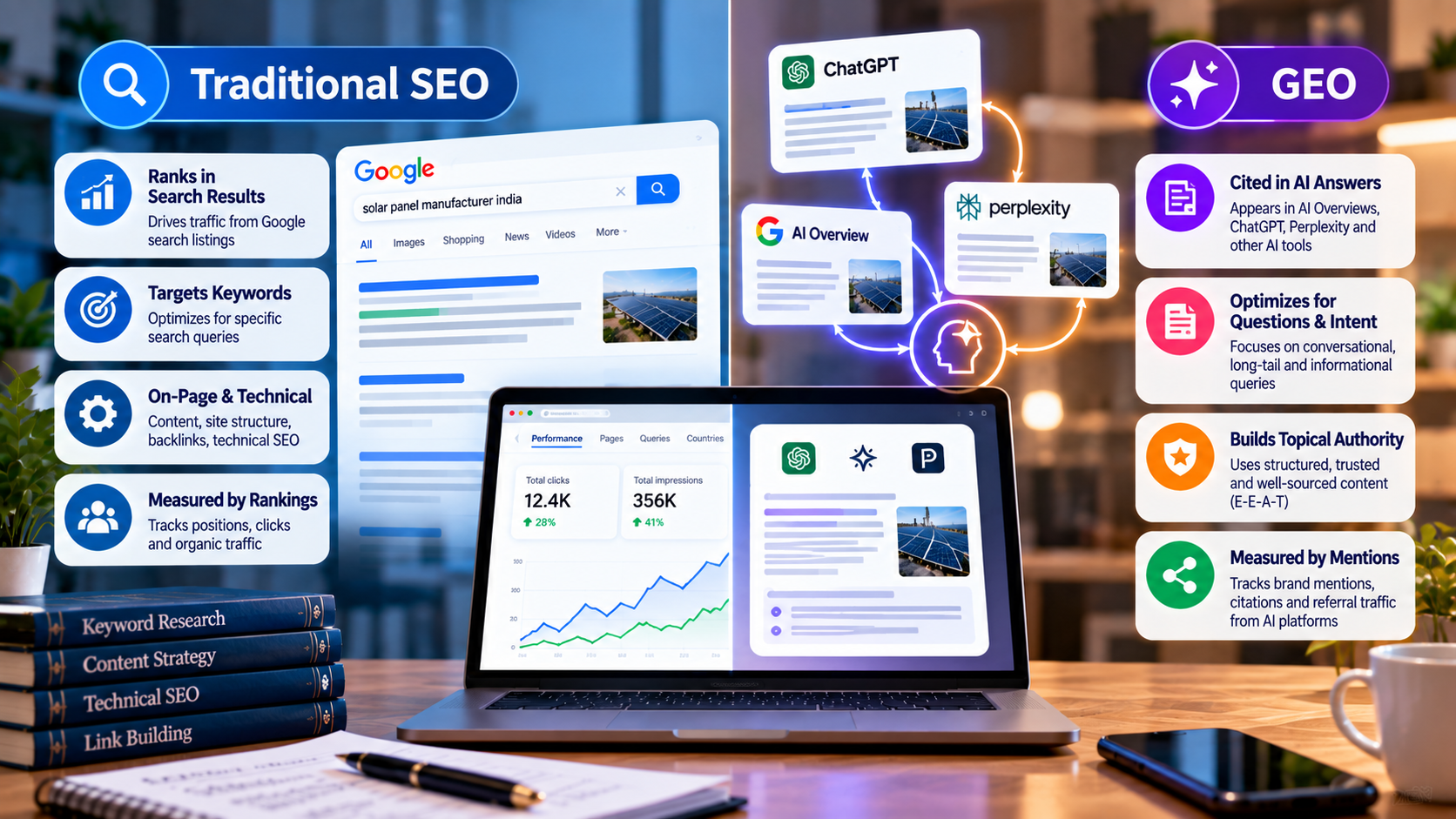
Where GEO and Traditional SEO Diverge (and Where They Don’t)
|
Factor |
Traditional SEO |
Generative Engine Optimization |
|
Primary goal |
Rank in top positions for a click |
Get cited/extracted as a trusted source |
|
Content structure |
Keyword-optimized, can be narrative |
Direct-answer-first, highly extractable |
|
Authority signal |
Backlink profile, domain authority |
Corroboration across independent sources |
|
Technical layer |
robots.txt, sitemap, schema |
Same, plus emerging llms.txt conventions |
|
Measurement |
Rank tracking, organic traffic |
Citation frequency, AI referral traffic (emerging) |
The overlap is larger than the divergence — genuinely helpful, well-structured, technically sound, trustworthy content performs well in both systems. GEO is best understood as sharpening that same foundation for a new kind of consumption, not replacing it.
Common GEO Mistakes to Avoid
- Treating GEO as a separate content strategy rather than a refinement of existing SEO fundamentals
- Burying direct answers deep in long paragraphs instead of leading with them
- Skipping schema markup because “it’s for developers” — most FAQ and Organization schema is straightforward to implement even on standard CMS platforms
- Making unsupported claims with no external corroboration, which generative systems are specifically designed to be skeptical of
- Ignoring authorship and dating, both of which are increasingly weighted trust signals for AI-cited content
Bringing It All Together
Generative Engine Optimization isn’t a gimmick or a fad — it’s a genuine shift in how a growing share of searches get answered, and it rewards exactly the fundamentals good SEO has always valued: clarity, structure, corroborated authority, and real expertise. The businesses adapting now, by tightening content structure and reinforcing trust signals, are positioning themselves to be the source AI systems actually reach for — while competitors relying on thin, unstructured content quietly become invisible in this new layer of search.
If you want a clear picture of how your current content stacks up for both traditional and AI-driven search, our SEO services team can review your setup, or start with a free SEO audit report to see the highest-impact gaps first.
