
If you’ve ever typed “personal injury lawyer near me” into Google, you already understand the problem every law firm is fighting: three names show up in the map pack, a handful more in the organic results below, and everyone else is fighting over page two — which, for practical purposes, doesn’t exist.
Legal SEO isn’t the same beast as SEO for a retail store or a SaaS product. The keywords are more expensive (some personal injury and family law terms cost $50–$150+ per click on Google Ads, which is exactly why ranking organically matters so much more here than in most industries). The buyer is often anxious, in a hurry, and comparing three or four firms in the space of twenty minutes. And Google treats legal content as YMYL — “Your Money or Your Life” — which means trust signals matter more than almost any other niche outside of medicine and finance.
This guide walks through what actually moves the needle for a law firm’s search visibility in 2026, without the recycled “add your NAP consistently” advice you’ve read fifty times already.
Why Generic SEO Advice Fails Law Firms
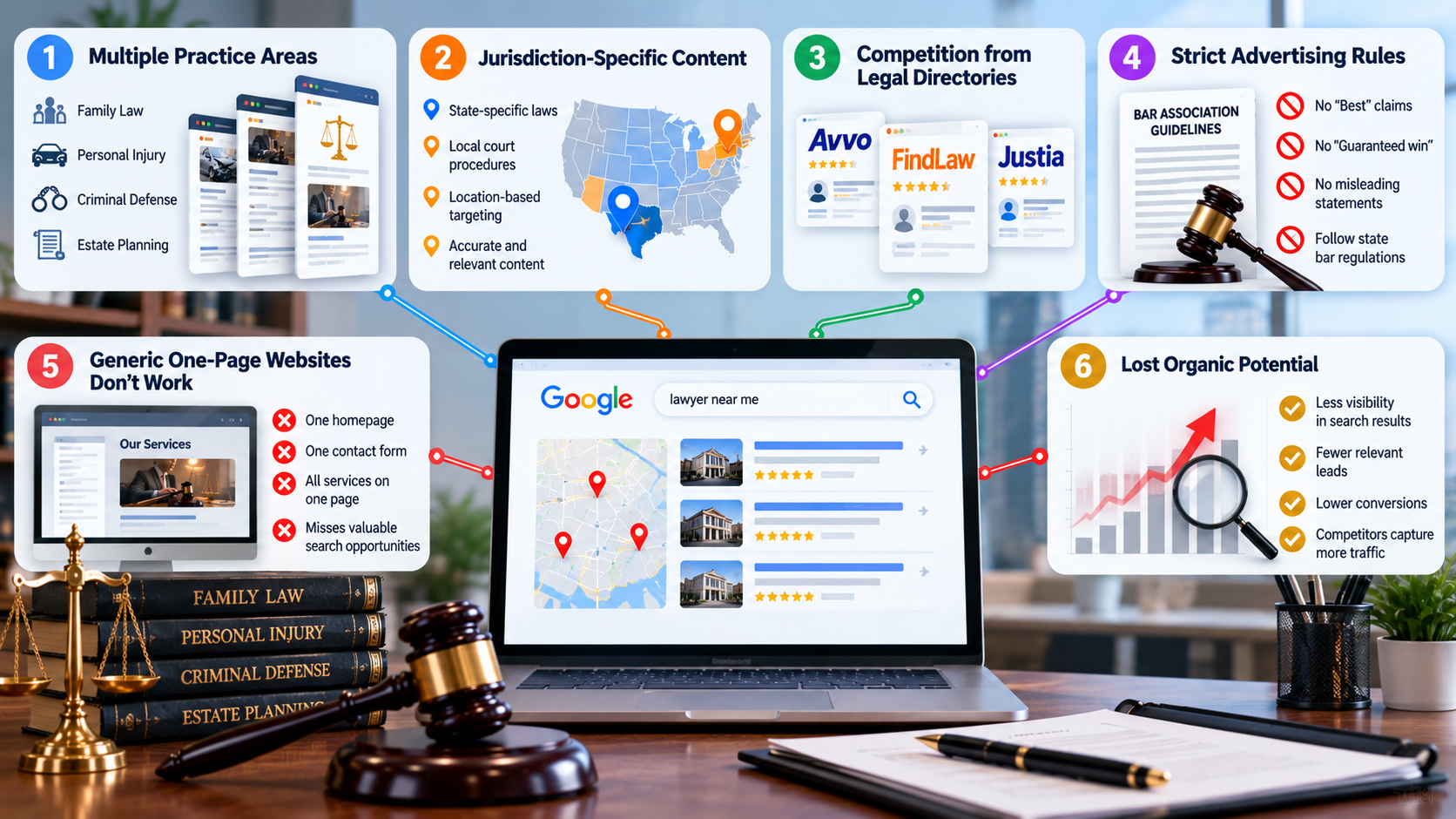
Most SEO checklists assume a business with one location, one service, and a straightforward buyer journey. Law firms rarely fit that mold:
- Multiple practice areas (family law, personal injury, criminal defense, estate planning) that each need their own targeting strategy, not one blended “services” page
- Jurisdiction-specific content — a custody guide for Texas is legally different from one for New York, and Google can tell when content is generic versus locally accurate
- Heavy competition from directories like Avvo, FindLaw, and Justia that often outrank individual firm websites
- Strict advertising rules in many bar associations that limit how aggressively you can make claims (“best,” “guaranteed win,” etc.)
A firm that treats its website like a digital business card — one homepage, one contact form, a list of services — is leaving almost all of its organic potential on the table.
Step 1: Build Practice-Area Pages, Not a Services List
The single biggest structural mistake law firm websites make is bundling everything under one “Practice Areas” page with a paragraph per topic. Each practice area — and often each sub-specialty within it — deserves its own dedicated, in-depth page.
A strong practice-area page typically includes:
- A clear explanation of what the practice area covers and who it’s for
- Realistic answers to the questions a worried prospective client actually has (What does this cost? How long does it take? What happens at the first meeting?)
- Jurisdiction-specific detail — statutes, timelines, or local court procedures relevant to your state or city
- Attorney bios linked from the page, showing direct experience in that exact area
- A distinct, keyword-relevant title tag and URL (e.g., /practice-areas/car-accident-lawyer/ rather than /services#accidents)
Firms that build this out properly consistently see practice-area pages outperform the homepage for organic traffic within a few months, simply because each page can target its own cluster of long-tail searches (“motorcycle accident lawyer,” “wrongful death attorney,” “DUI defense first offense”) instead of competing with itself for one broad term.
Step 2: Win the Local Pack Before You Worry About Organic Rank #1
For almost every practice area with a physical office and local clientele, the map pack (the three listings shown with the map at the top of local searches) drives more calls than the blue links below it. That means your Google Business Profile deserves as much strategic attention as your website.
Key levers for law firm local pack visibility:
- Category accuracy — choose the most specific primary category available (e.g., “Personal Injury Attorney” rather than the generic “Lawyer”)
- Consistent NAP (Name, Address, Phone) across your website, GBP, and every legal directory you’re listed on
- Q&A section usage — proactively answer the questions people actually ask before a consultation
- Photos of your actual office and team — profiles with real photography consistently get more engagement than stock imagery
- Review velocity, not just review count — a steady trickle of new reviews signals an active, trustworthy practice better than 200 reviews from three years ago
If your firm serves multiple cities from one office or has multiple branches, you’ll also want location-specific landing pages that are genuinely differentiated — not the same page with the city name swapped out, which Google’s algorithms are increasingly good at detecting and discounting.
Step 3: Reviews Are Your Highest-Leverage Trust Signal — Handle Them Correctly
Legal services are bought almost entirely on trust, and reviews are the fastest trust signal a stranger can evaluate. But most bar associations have specific rules about soliciting, responding to, and even displaying reviews — so this isn’t a “just ask everyone” situation the way it might be for a restaurant.
A sustainable review system for a law firm should:
- Ask for reviews at a moment tied to a genuine resolution (case closed, milestone reached) rather than immediately after intake
- Never offer any incentive, discount, or compensation for a review — this violates most jurisdictions’ advertising rules and Google’s own policies
- Respond to every review, positive or negative, in a way that never discloses confidential case details (a firm can be sanctioned for confirming even the existence of an attorney-client relationship in a public reply)
- Route unhappy clients to a private resolution channel first, rather than letting a dispute play out publicly
Firms that build genuine review workflows into their client-offboarding process — rather than treating it as an afterthought — see meaningfully stronger local pack performance over time. If you want a deeper breakdown of ethical, non-pushy review generation tactics, our guide on organic ways to get more reviews covers the mechanics in more detail.
Step 4: Content That Answers Real Questions (and Earns E-E-A-T)
Google’s guidance on helpful content puts particular weight on Experience, Expertise, Authoritativeness, and Trust for YMYL topics — and legal content sits squarely in that category. This means thin, AI-generated “what to do after a car accident” listicles with no attorney input are increasingly unlikely to rank, no matter how well the keywords are placed.
What tends to work instead:
- Attorney-authored or attorney-reviewed articles, with a visible byline and a link to the attorney’s credentials
- Real case outcomes (anonymized or generalized where confidentiality requires it) that demonstrate actual experience, not textbook theory
- FAQ-style content structured to directly answer the exact questions people type into Google before hiring a lawyer — “how much does a divorce cost,” “do I need a lawyer for a small car accident,” “what happens if I miss a court date”
- Process breakdowns that de-mystify what happens after someone calls — this reduces the anxiety that keeps people from picking up the phone
This is also where structured content pays off for AI-driven search. When a prospective client asks ChatGPT or Google’s AI Overviews “do I need a lawyer for a DUI in [state],” well-structured, clearly attributed legal content is far more likely to be surfaced and cited than a generic paragraph buried in a sidebar. We go deeper into optimizing content specifically for AI-generated answers in our guide on understanding GEO, AEO, and their impact on SEO strategy.
Step 5: Technical Foundations You Can’t Skip
Even the best legal content underperforms on a slow, poorly structured site. A few law-firm-specific technical priorities:
- Schema markup for Attorney, LegalService, and FAQPage types, which helps search engines and AI systems understand exactly what your site offers and who’s behind it
- Mobile performance — a huge share of legal searches happen from a phone in a moment of stress (right after an accident, an arrest, or a family crisis), so a slow-loading mobile site directly costs consultations
- Secure, accessible intake forms that don’t require a phone call as the only path to contact
- Clean internal linking between practice-area pages, attorney bios, and related blog content, so both users and search engines can navigate the site’s topical depth easily
If your site hasn’t had a technical review recently, our technical SEO guide is a useful starting checklist before you invest further in content.
Step 6: Off-Page Signals That Matter for Law Firms Specifically
Backlinks and citations for legal sites carry particular weight because of how competitive and trust-sensitive the space is. Priority sources include:
- Bar association directories and local chamber of commerce listings
- Legitimate legal directories (beyond just claiming a free profile — completing them fully, with photography and detailed practice descriptions)
- Local press mentions — settlements, community involvement, or commentary on relevant local legal news
- Guest contributions to legitimate local business or community publications, rather than mass-produced guest post networks
Quality and relevance matter far more than volume here. A handful of links from your local bar association and a regional news outlet will outperform dozens of low-quality directory submissions. Our approach to sustainable link acquisition is covered in more depth in our link building services overview.
Common Legal SEO Mistakes Worth Avoiding
- Duplicating practice-area content across multiple city pages with only the location name changed
- Ignoring the Q&A section on Google Business Profile, which competitors and even random users can populate if you don’t
- Ghost-writing testimonials or reviews, which risks both bar sanctions and Google penalties for fake reviews
- Treating the blog as an afterthought, publishing sporadically instead of building a consistent library of the exact questions your intake team hears every week
Bringing It All Together
Legal SEO rewards firms that treat their website the way they’d treat a courtroom argument: specific, well-supported, and built around what the audience actually needs to hear — not generic claims. Practice-area depth, a well-managed Google Business Profile, an ethical review pipeline, and genuinely expert-authored content will outperform keyword-stuffed pages every time, and increasingly, it’s what determines whether AI-driven search tools recommend your firm at all.
If you’d rather have a team that already understands both the SEO mechanics and the compliance boundaries handle this for you, our SEO services team can start with a full audit of where your firm currently stands — you can request a free SEO audit report to see exactly where the gaps are before committing to anything.
