
Most SEO advice is written for businesses where someone searches, clicks, and buys within minutes or days. Manufacturer and B2B supplier SEO doesn’t work that way. A procurement manager researching industrial pumps, a construction firm sourcing solar components, or a distributor comparing suppliers for a new product line might spend weeks — sometimes months — moving from an anonymous Google search to an actual RFQ (request for quote).
That long, research-heavy buying cycle changes almost everything about how SEO should be approached: which keywords matter, what a “conversion” even looks like, and how content needs to be structured to stay useful across a multi-stage decision process involving several people, not just one buyer.
This guide breaks down what actually works for manufacturers, suppliers, and B2B dealers trying to build organic visibility that produces real quote requests — not just traffic.
Why Standard SEO Playbooks Underperform for Manufacturers
A few structural realities make B2B manufacturing SEO fundamentally different from consumer-facing SEO:
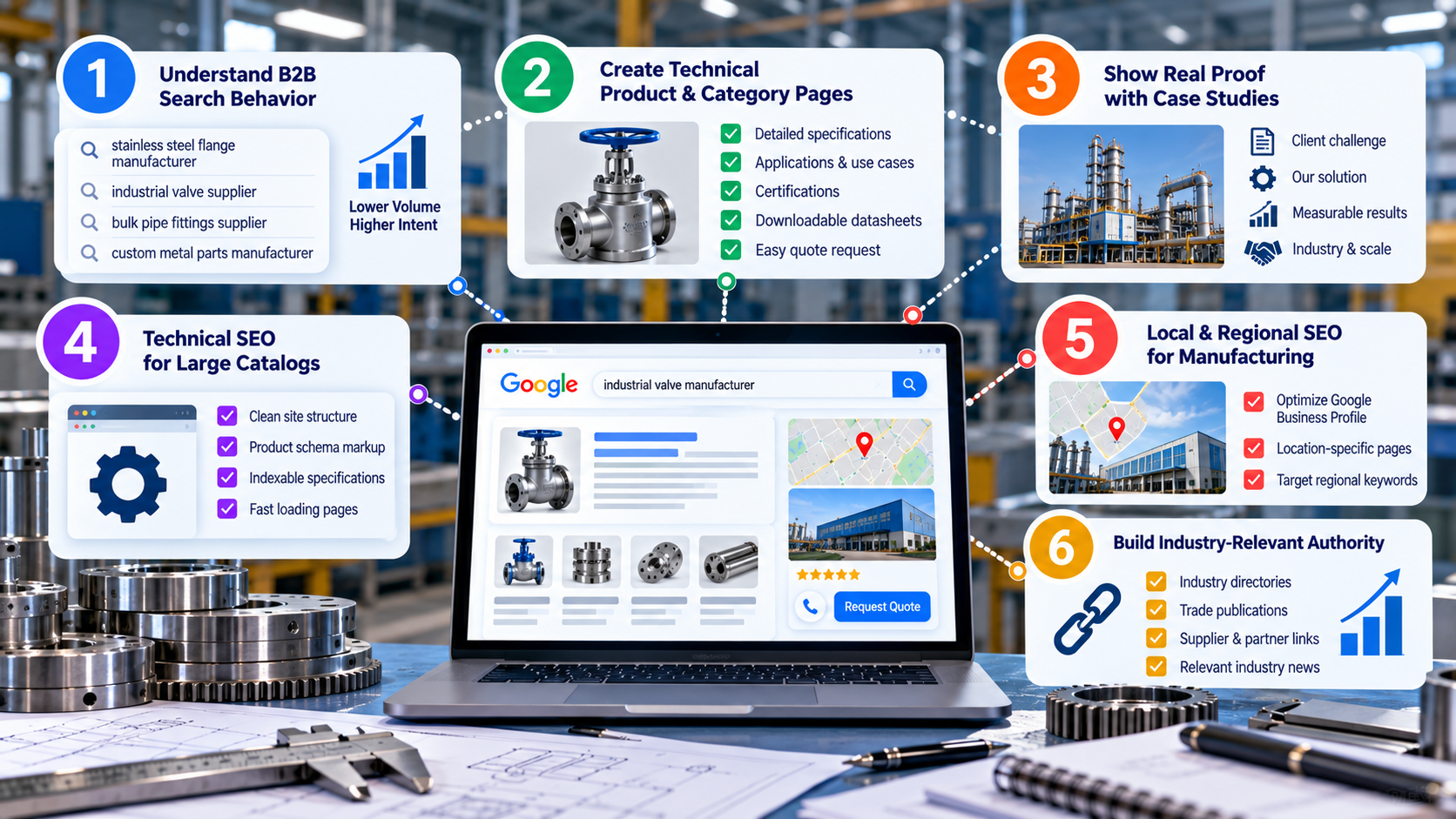
- Search volume is often low, but intent is extremely high. A term like “stainless steel flange manufacturer India” might get a few hundred searches a month, but nearly every searcher is a genuine potential buyer, not a browser
- Multiple decision-makers — an engineer researching specs, a procurement officer comparing pricing, and a plant manager weighing reliability may all interact with your site at different points
- Products are often highly technical, meaning generic marketing copy fails to answer the questions that actually drive a purchase decision
- Trust and track record matter enormously — B2B buyers are placing large, often recurring orders, so certifications, case studies, and proof of reliability outweigh flashy design
Treating a manufacturer’s website like a consumer e-commerce store — generic category pages, thin product descriptions, stock photography — leaves almost all of the organic opportunity on the table.
Step 1: Build Keyword Strategy Around the Buying Committee, Not Just “The Buyer”
Because B2B purchases usually involve several stakeholders, your keyword and content strategy should map to each of their concerns:
|
Stakeholder |
Typical Search Intent |
Content That Serves It |
|
Engineer / technical evaluator |
Specs, tolerances, compatibility, certifications |
Detailed spec sheets, technical datasheets, compatibility guides |
|
Procurement / purchasing |
Pricing structure, MOQs, lead times, supplier reliability |
Pricing transparency pages, case studies, delivery timelines |
|
Plant manager / end user |
Durability, maintenance needs, real-world performance |
Application guides, comparison content, testimonials |
Most manufacturer websites only write for the first group (technical specs) and completely ignore the content that helps procurement and end-users say yes. Filling that gap is often the single biggest opportunity available.
Step 2: Product and Category Pages That Actually Convert Research Into Quotes
Generic product listings with a single paragraph and a “contact us” button consistently underperform for B2B. A stronger structure includes:
- Full technical specifications presented clearly (tables outperform paragraphs for this kind of data, both for users and for search engines parsing structured content)
- Application-specific detail — which industries or use cases this product actually fits, described specifically rather than vaguely (“suitable for various applications”)
- Certifications and compliance standards clearly listed and, where possible, verifiable (ISO, CE, industry-specific certifications)
- Downloadable resources — spec sheets, CAD files, or datasheets, which also tend to earn backlinks from industry directories and partner sites
- A low-friction quote request path that doesn’t force a phone call as the only option, since many B2B buyers prefer to gather information before ever speaking to sales
Category pages, meanwhile, should be built around how buyers actually search and compare — by material, by application, by industry — rather than purely by internal product-line naming that means nothing to an outside searcher.
Step 3: Case Studies and Proof Are Your Strongest Content Asset
In consumer SEO, reviews are the dominant trust signal. In B2B manufacturing, it’s case studies and proof of delivery at scale. A well-built case study should include:
- The specific problem the client faced
- Why they chose this particular product or process over alternatives
- Measurable outcomes — cost savings, durability improvements, timeline performance
- Real specifics (industry, scale, region) rather than vague, anonymized claims
Case studies also happen to be excellent long-tail SEO assets, since they naturally target searches like “[industry] supplier for [specific application]” that generic product pages can’t capture on their own. They double as content that AI-driven search tools increasingly favor when answering comparison-style B2B queries, because they contain concrete, verifiable detail rather than generic marketing language.
Step 4: Technical SEO Considerations Specific to Manufacturers
Manufacturer websites often carry structural baggage that quietly suppresses rankings:
- Massive, poorly organized product catalogs with thin or duplicate content across near-identical SKUs
- PDF-only spec sheets with no accompanying indexable text, meaning search engines (and AI tools) can’t read the actual specifications
- Weak internal linking between related products, applications, and supporting content, making it hard for both users and crawlers to understand the full catalog depth
- Slow-loading catalog and filter pages, especially on sites with large product databases and heavy imagery
Implementing Product and Organization schema markup, consolidating near-duplicate SKU pages where appropriate, and ensuring key specs exist as real text (not locked inside a PDF or image) are consistently high-impact, low-cost fixes. Our technical SEO guide covers the underlying mechanics in more depth.
Step 5: Local and Regional SEO Still Matters — Even for B2B
It’s a common assumption that manufacturers don’t need local SEO because they ship nationally or internationally. In practice, regional relevance still matters for several reasons:
- Buyers frequently prefer suppliers within a reasonable shipping radius to reduce freight costs and lead times
- “Near me” and regional modifiers (“manufacturer in [state/region]”) are common in B2B search behavior, particularly for buyers prioritizing faster turnaround
- A properly optimized Google Business Profile for the manufacturing facility itself — even without retail foot traffic — helps establish location trust and can surface in relevant local commercial searches
If your business serves distinct regional markets, dedicated location or region-specific landing pages (built with genuinely unique content, not templated duplicates) can capture meaningful additional visibility. Our local SEO guide for SMEs walks through the fundamentals that still apply here.
Step 6: Link Building and Authority for Industrial and B2B Sites
Backlinks for manufacturers typically come from a different set of sources than consumer businesses:
- Industry associations and trade bodies, which often maintain member directories with linking opportunities
- Supplier and distributor partner pages, where reciprocal or genuine partnership links are both natural and valuable
- Trade publications and industry news sites, particularly around new product launches, certifications, or capacity expansions
- Technical documentation hosted externally (engineering forums, spec-sharing platforms) that link back to the source manufacturer
Volume matters far less here than relevance — a single link from a respected trade association or industry publication typically carries more weight than dozens of generic directory submissions. Our link building services approach prioritizes exactly this kind of targeted, industry-relevant acquisition.
Common Manufacturer SEO Mistakes to Avoid
- Publishing specs only as PDFs, leaving search engines and AI tools with nothing readable to index
- Writing for engineers only, ignoring the procurement and end-user content that actually moves a deal forward
- Duplicating content across near-identical product variants instead of consolidating or meaningfully differentiating them
- Skipping case studies entirely, missing one of the strongest trust and long-tail SEO assets available in B2B
- Treating the website as a static brochure rather than an ongoing content and lead-generation asset
Bringing It All Together
Manufacturer and B2B supplier SEO isn’t about chasing high search volume — it’s about capturing a smaller number of extremely high-intent searches from buyers who are already deep in a research process, and giving every stakeholder in that buying committee the specific information they need to move forward. Technical depth, real case studies, accessible specifications, and targeted industry authority consistently outperform generic B2B marketing copy.
If your product catalog or supplier site could use a structural and content review, our SEO services team can start with a full audit — you can request a free SEO audit report to see exactly where the highest-impact gaps are.
